Research Report
Multi-Sector Holdings (Overweight/Initiate)Conditions for narrowing the holding company discount
- Author Jay JH Ryu
- Date Thu Aug 06 00:00:00 KST 2026
- Stock Code 000880 / 001040 / 003550 / 006260 / 009540 / 009830 / 010120 / 012450 / 051910 / 064400 / 066570 / 267250 / 267260
- File 20260806_Multi-Sector Holdings (Overweight_Initiate).pdf
Conditions for narrowing the holding company discount
Rethinking the holding company discount
Korean holding companies have historically traded at a significant discount to NAV. Structural factors that are difficult to change in the short term―including separate parent-subsidiary listings, conflicts of interest between controlling and minority shareholders, and double leverage―justify a baseline discount in the 20% range. The remaining 20?35%p of observed discounts reflects market skepticism that subsidiary earnings and cash will ultimately reach holding company shareholders. Over the long term, this additional discount is therefore determined largely by management’s credibility regarding the delivery of shareholder returns.
In this report, we attempt to quantify this skepticism by tracking the pathway through which subsidiary earnings pass through the holding company and are ultimately returned to shareholders. We assess this pathway across three dimensions:
1) Conversion: The proportion of consolidated net profit attributable to owners of the parent that is captured as dividend income.
2) Capacity: The extent to which recurring cash inflows can fund shareholder returns.
3) Trust: Confidence that management will follow through on its shareholder return commitments, based on disclosed policies and actual implementation.
Capacity measures whether recurring cash inflows at the holding company level are sufficient to sustain cash dividends to shareholders. It is scored based on the multiple by which dividends received from subsidiaries and net contractual income cover cash dividends paid to holding company shareholders. Our primary standardized measure is dividend coverage, calculated as the holding company’s standalone dividend income divided by its total cash dividends to shareholders. We cross-check this result using adjusted coverage, which broadens the funding base to include brand royalties, rental income, and recurring FCF from the holding company’s own operations.
For the Trust dimension, because dividend policies differ across companies, we assess each company against the terms of its own policy rather than against a common shareholder return ratio. Company-specific policies can take the form of subsidiary dividend pass-through models, standalone earnings-linked payout policies, or minimum DPS commitments.


Contact Us
- Office number1588-6800
-
- Investor Relationsirteam@miraeasset.com
- Human Resourcerecruit@miraeasset.com
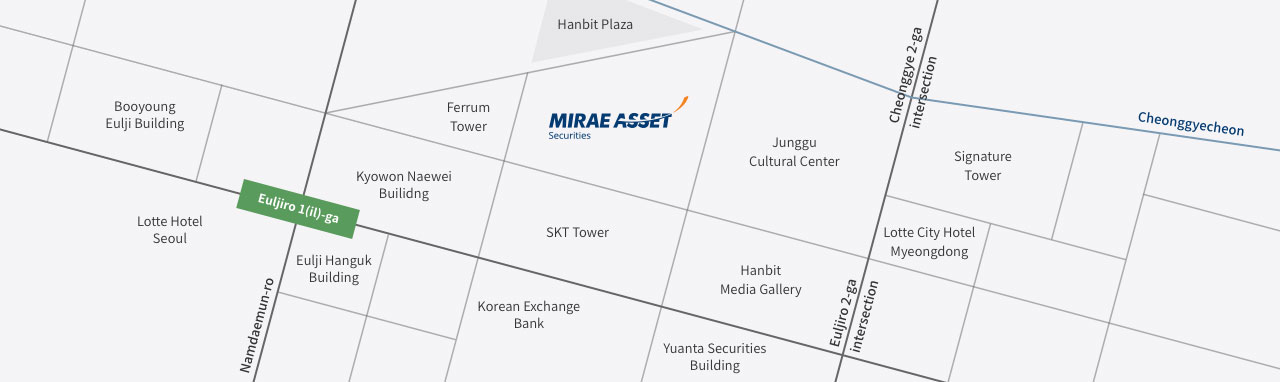
- AddressMirae Asset CENTER1 Bldg, East Tower, 26, Euljiro 5 gil, Jung-gu, Seoul 100-210
Korea (Headquarters)
Greece
Luxembourg
- Mirae Asset Global Investment(SICAV)
Mongolia
USA
- Mirae Asset Securities &
Investments Mirae Asset Securities(NY)
- Mirae Asset Global Investments
- Global X
- Mirae Asset Capital Life Science
- Wealthspot
Vietnam
- Mirae Asset Securities
- Mirae Asset Finance Company
- Mirae Asset Prevoir Life Insurance
- Mirae Asset Global Investments
- Vina Digital Finance Platform
- Grooo International Joint Stock
Company Mirae Asset Alternative
Invetment VietnamMirae Asset Securities
- Ho Chi Minh representative Ofiice
Brazil
Singapore
United Arab Emirates
Mirae Asset Investment Managers
- Dubai representative Office
Ireland
United Kingdom
India
Indonesia
Japan
China
- Mirae Asset Huachen Fund
Management Mirae Asset Investment
Management(Shanghai)Mirae Asset Securitires
(Beijing representative Office)Mirae Asset Securitires
(Shanghai representative Office)
Canada
Colombia
Australia
Hong Kong SAR*
Germany
Global X ETFs - Germany Rep Office
Italy
Global X ETFs - Italy Rep Office
* Special Administrative Region of the People’s Republic of China